
U.S.-Iran Military Tensions and Ceasefire Collapse
What began as maritime friction escalated into a direct military conflict between the U.S. and Iran, marked by infrastructure destruction and a $37.5 billion war bill. Following a peak of multi-domain warfare, the narrative pivoted toward transactional diplomacy as President Trump paused strikes under pressure from Gulf allies. By August 6, the story transitioned into a 'deal-making' phase focused on securing the Strait of Hormuz through Omani mediation, though skepticism remains regarding Iranian compliance.
- CEASEFIRE COLLAPSE AND MILITARY ESCALATION: The U.S. resumed strikes on Iran after maritime attacks, with Trump declaring the ceasefire over; coverage shifted from tactical retaliation to a broader strategic 'blockade' and the formal end of diplomacy.
- TRANSITION TO ACTIVE REGIONAL WARFARE: Coverage shifted from the 'end of a truce' to the 'start of a war' as reciprocal strikes intensified along the Iranian coast and the Strait of Hormuz.
- INTELLIGENCE THREATS AND LEADERSHIP TARGETING: The narrative expanded to include intelligence-led reports of direct assassination threats against President Trump, personalizing the conflict beyond military maneuvers.
- STRATEGIC STANDOFF AND POLITICAL ACCOUNTABILITY: The conflict settled into a standoff over the Strait of Hormuz, with media shifting from combat reporting to judging the administration's strategic competence.
- TRANSACTIONAL WARFARE AND NAVAL TOLLS: The U.S. reimposed a formal blockade and announced transit tolls for commercial vessels, shifting the narrative toward economic control and market disruption.
- POLICY RETREAT AND ONGOING KINETIC EXCHANGE: The administration signaled a tactical retreat from the controversial tolling plan as Iran continued retaliatory strikes, creating a sharp media disconnect between outlets focused on the diplomatic walk-back and those still covering active military exchanges.
- ENTRENCHED IMPASSE AND FOREVER WAR WARNINGS: The crisis transitioned into a deadlock of reciprocal barrages; reporting shifted to internal administration friction and media warnings that the U.S. is entering a systemic foreign policy failure.
- INFRASTRUCTURE WARFARE AND REGIONAL ESCALATION: The conflict moved beyond maritime skirmishes into a systematic air campaign targeting civilian infrastructure like plants and bridges, with major outlets adopting 'War with Iran' terminology.
- NATIONAL RETRIBUTION AND KINETIC ESCALATION: Following the deaths of U.S. service members in Jordan, the narrative shifted from policy debate to war reporting and demands for national vengeance, while the Pentagon faced scrutiny over transparency regarding military injuries.
- FISCAL ACCOUNTABILITY AND STRATEGIC STALEMATE: Media focus shifted to the massive $37.5 billion financial cost of the conflict and the lack of military effectiveness as Iranian missile barrages persisted. By July 24, the narrative integrated global economic anxiety as oil prices surged past $100 and Congress moved to challenge executive war powers.
- DOMESTIC ECONOMIC TOLL AND LEADERSHIP SECURITY: The story pivoted to the 'pocketbook stress' of $100 oil prices affecting American consumers, while reports of the President switching jets due to security threats personalized the geopolitical crisis.
- DIPLOMATIC PAUSE AND STRATEGIC LIMITS: A tentative two-day pause in hostilities emerged to facilitate Omani-led diplomacy, but the narrative quickly collapsed back into active conflict by July 29 as Iran launched missile attacks, signaling the failure of diplomatic efforts.
- MULTI-DOMAIN REGIONAL WARFARE: Diplomacy collapsed as the U.S. launched strikes on dozens of targets in Iran. The conflict expanded into the digital domain with cyberattacks on U.S. utilities and a shift toward long-term industrial mobilization for war.
- DIPLOMATIC PIVOT AND GULF MEDIATION: The narrative underwent a sudden shift as President Trump announced the voiding of planned strikes in favor of negotiations, reportedly influenced by Gulf allies. By August 5, skepticism emerged as world leaders appeared desensitized to threats.
- REGIONAL DEAL-MAKING AND HORMUZ MEDIATION: The conflict transitioned into a deal-making mode, with reports of a nearing agreement between Iran and Oman regarding the Strait of Hormuz.
Paper Trail · Full Arc
U.S.-Iran Military Tensions and Ceasefire Collapse
What began as maritime friction escalated into a direct military conflict between the U.S. and Iran, marked by infrastructure destruction and a $37.5 billion war bill. Following a peak of multi-domain warfare, the narrative pivoted toward transactional diplomacy as President Trump paused strikes under pressure from Gulf allies. By August 6, the story transitioned into a 'deal-making' phase focused on securing the Strait of Hormuz through Omani mediation, though skepticism remains regarding Iranian compliance.
Story Phases
CEASEFIRE COLLAPSE AND MILITARY ESCALATION
8 Jul — 9 JulThe U.S. resumed strikes on Iran after maritime attacks, with Trump declaring the ceasefire over; coverage shifted from tactical retaliation to a broader strategic 'blockade' and the formal end of diplomacy.
Military escalation, economic sanctions, and the end of diplomacy.
TRANSITION TO ACTIVE REGIONAL WARFARE
10 Jul — 11 JulCoverage shifted from the 'end of a truce' to the 'start of a war' as reciprocal strikes intensified along the Iranian coast and the Strait of Hormuz.
Grim inevitability of regional war and tactical exchange of strikes.
INTELLIGENCE THREATS AND LEADERSHIP TARGETING
12 JulThe narrative expanded to include intelligence-led reports of direct assassination threats against President Trump, personalizing the conflict beyond military maneuvers.
Personal security risk to leadership and intelligence-based threat assessment.
STRATEGIC STANDOFF AND POLITICAL ACCOUNTABILITY
13 JulThe conflict settled into a standoff over the Strait of Hormuz, with media shifting from combat reporting to judging the administration's strategic competence.
Strategic failure and regional blockade.
TRANSACTIONAL WARFARE AND NAVAL TOLLS
14 JulThe U.S. reimposed a formal blockade and announced transit tolls for commercial vessels, shifting the narrative toward economic control and market disruption.
Transactional power play and macroeconomic fallout.
POLICY RETREAT AND ONGOING KINETIC EXCHANGE
15 JulThe administration signaled a tactical retreat from the controversial tolling plan as Iran continued retaliatory strikes, creating a sharp media disconnect between outlets focused on the diplomatic walk-back and those still covering active military exchanges.
Policy instability and the deflation of transactional framing amid persistent warfare.
ENTRENCHED IMPASSE AND FOREVER WAR WARNINGS
16 Jul — 17 JulThe crisis transitioned into a deadlock of reciprocal barrages; reporting shifted to internal administration friction and media warnings that the U.S. is entering a systemic foreign policy failure.
Strategic deadlock and the risk of long-term military engagement.
INFRASTRUCTURE WARFARE AND REGIONAL ESCALATION
18 JulThe conflict moved beyond maritime skirmishes into a systematic air campaign targeting civilian infrastructure like plants and bridges, with major outlets adopting 'War with Iran' terminology.
Regional conflagration and infrastructure destruction.
NATIONAL RETRIBUTION AND KINETIC ESCALATION
19 Jul — 21 JulFollowing the deaths of U.S. service members in Jordan, the narrative shifted from policy debate to war reporting and demands for national vengeance, while the Pentagon faced scrutiny over transparency regarding military injuries.
National retribution and institutional transparency.
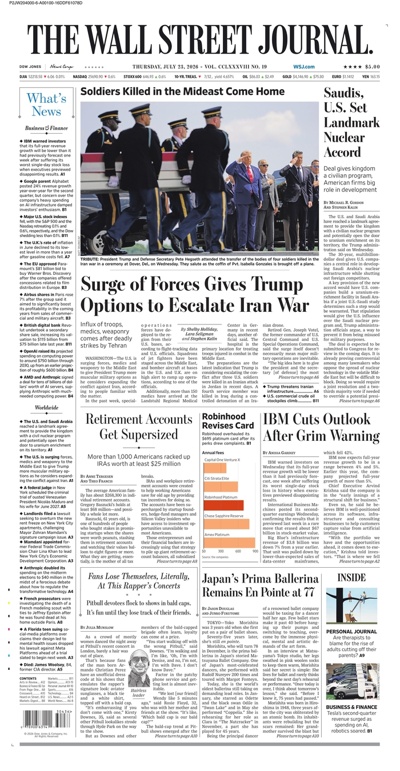 Wall Street Journal
FISCAL ACCOUNTABILITY AND STRATEGIC STALEMATE
22 Jul — 24 JulMedia focus shifted to the massive $37.5 billion financial cost of the conflict and the lack of military effectiveness as Iranian missile barrages persisted. By July 24, the narrative integrated global economic anxiety as oil prices surged past $100 and Congress moved to challenge executive war powers.
Fiscal skepticism, strategic stalemate, and global economic instability.
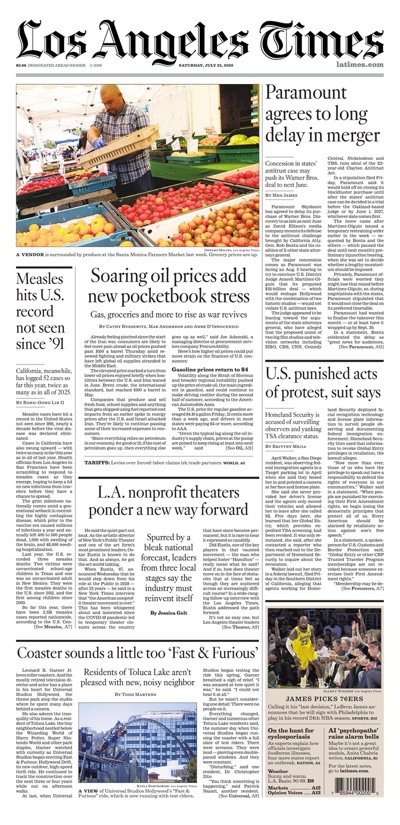 Los Angeles Times
DOMESTIC ECONOMIC TOLL AND LEADERSHIP SECURITY
25 Jul — 26 JulThe story pivoted to the 'pocketbook stress' of $100 oil prices affecting American consumers, while reports of the President switching jets due to security threats personalized the geopolitical crisis.
Consumer economic anxiety and executive security risk.
 Wall Street Journal
DIPLOMATIC PAUSE AND STRATEGIC LIMITS
27 Jul — 29 JulA tentative two-day pause in hostilities emerged to facilitate Omani-led diplomacy, but the narrative quickly collapsed back into active conflict by July 29 as Iran launched missile attacks, signaling the failure of diplomatic efforts.
Tactical de-escalation followed by diplomatic failure and renewed kinetic exchange.
 Wall Street Journal
MULTI-DOMAIN REGIONAL WARFARE
30 Jul — 2 AugDiplomacy collapsed as the U.S. launched strikes on dozens of targets in Iran. The conflict expanded into the digital domain with cyberattacks on U.S. utilities and a shift toward long-term industrial mobilization for war.
Regional war expansion, multi-domain conflict, and industrial mobilization.
 Wall Street Journal
DIPLOMATIC PIVOT AND GULF MEDIATION
3 Aug — 5 AugThe narrative underwent a sudden shift as President Trump announced the voiding of planned strikes in favor of negotiations, reportedly influenced by Gulf allies. By August 5, skepticism emerged as world leaders appeared desensitized to threats.
Presidential agency in de-escalation and regional realpolitik.
 Wall Street Journal
REGIONAL DEAL-MAKING AND HORMUZ MEDIATION
6 AugThe conflict transitioned into a deal-making mode, with reports of a nearing agreement between Iran and Oman regarding the Strait of Hormuz.
Cautious optimism and transactional regional diplomacy.
Newspaper Stances
Wall Street Journal
Economic and strategic; focuses on market volatility, the depletion of the Strategic Petroleum Reserve, and internal White House escalation debates.
Washington Post
Legally and strategically focused; tracks the transition from administration optimism to documenting a structural diplomatic impasse and infrastructure damage.
New York Times
Psychological and leadership-focused; uses the visibility of key actors and terminology shifts as a metric for crisis intensity.
Philadelphia Inquirer
Factual but increasingly critical; frames the conflict as a systemic failure and a risk of prolonged military engagement.
Arizona Republic
High-alarm and kinetic; emphasizes the bilateral military exchange and physical reality of strikes, while providing localized context for casualties.
Minnesota Star Tribune
Policy-oriented and measured; tracks administrative developments and institutional transparency.
Coverage Map
Daily Log
Iran, Oman Near Hormuz Deal
The story settles into a deal-making mode, with specialized business and energy-focused papers leading on regional mediation efforts.
Trump keeps making threats. World leaders aren't blinking.
Narrative shifts to cynical stability; media observes global desensitization to threats while strategic focus narrows to the Strait of Hormuz.
Trump says he voided strikes
Sudden pivot to diplomacy; WSJ attributes the shift to Gulf ally influence, creating a narrative of whiplash from previous aggression.
U.S. hits dozens of targets in Iran
Peak alarm phase; regional papers treat the conflict as a sustained crisis while national outlets detail deep-territory strikes.
Trump threatens ‘hard’ hit for Iran
Coverage reflects an escalatory cycle with high-alarm reporting on retaliatory strikes and fears of a multi-front regional war.